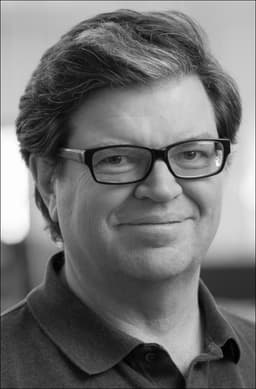
Visionary · b. 1960
Yann LeCun
He taught machines to see by designing the convolutional neural network, the architecture that underpins virtually every modern image recognition system.
“The idea is that you can achieve things that look like intelligence, but it's just a very sophisticated interpolation.”
— Interview with Wired, 2019
Yann LeCun was born in 1960 near Paris, France, and grew up during an era when computing was still the province of specialists and mainframes. He studied at the École Supérieure d'Ingénieurs en Électrotechnique et Électronique before completing his PhD at Pierre and Marie Curie University in 1987. As a graduate student he encountered the backpropagation algorithm and immediately grasped its potential — not merely as a theoretical tool, but as a practical engine for training multilayer networks on real-world data.
In 1988, LeCun joined Bell Labs, where he found the rare combination of freedom, computing resources, and a genuine applied problem: reading handwritten digits on checks and postal envelopes. Drawing on ideas from neuroscience — specifically the work of Hubel and Wiesel on the visual cortex — he designed a network architecture that imposed local connectivity and shared weights across spatial positions. The result was LeNet, demonstrated definitively in his landmark 1989 paper and refined through the 1990s. By 1998, LeNet-5 was processing a significant fraction of all checks deposited in the United States, running silently in banking infrastructure years before the term 'deep learning' entered common usage.
Recognition came slowly, then all at once. Through the 1990s and 2000s, interest in neural networks ebbed and LeCun continued his work at NYU's Courant Institute, where he had moved in 2003, developing ideas about energy-based models, sparse coding, and unsupervised learning. The ImageNet moment of 2012 — when a deep convolutional network by Krizhevsky, Sutskever, and Hinton demolished the competition — vindicated everything he had argued for two decades. In 2013 he became the founding director of Facebook AI Research (FAIR), and in 2018 he shared the Turing Award with Geoffrey Hinton and Yoshua Bengio, the trio known as the godfathers of deep learning.
Key Works
- 1989
Backpropagation Applied to Handwritten Zip Code Recognition
The first demonstration of a convolutional network trained end-to-end on a real-world visual task, establishing the core architecture that would define computer vision three decades later.
- 1998
Gradient-Based Learning Applied to Document Recognition
The definitive exposition of LeNet-5, introducing the full convolutional network framework with detailed comparisons to other methods and documenting its deployment in commercial check-reading systems.
- 2006
A Tutorial on Energy-Based Learning
A unifying theoretical framework proposing that many learning problems — classification, generation, structured prediction — can be expressed as energy minimization, broadening the conceptual scope of deep learning.
- 2015
Deep Learning (with Bengio and Hinton, Nature)
A landmark review article in Nature that synthesized the decade's advances in deep learning for a broad scientific audience, cementing the field's mainstream legitimacy.
- 2022
A Path Towards Autonomous Machine Intelligence
A position paper outlining LeCun's architecture for human-level AI grounded in self-supervised learning, world models, and reasoning — framing the next research agenda for the field.
LeCun's convolutional architecture directly seeded the explosion in computer vision that followed the 2012 ImageNet breakthrough. AlexNet was an explicit descendant of LeNet's design principles — local receptive fields, pooling layers, hierarchical feature extraction — scaled up with GPUs. Everything that followed, from VGGNet to ResNet to the vision transformers of the 2020s, inherited the problem framing and many structural intuitions he established. Autonomous vehicles, medical imaging diagnostics, satellite analysis, facial recognition, and industrial quality control all run on variants of the architecture LeCun pioneered at Bell Labs before most researchers considered it viable.
Beyond vision, LeCun's insistence that representation learning — letting networks discover their own features from data — was the correct path influenced the broader philosophy of modern machine learning. His advocacy for unsupervised and self-supervised learning, long before those terms were fashionable, shaped the research agenda at FAIR and pushed the field toward methods like contrastive learning and masked autoencoders. Researchers including Rob Fergus, Stéphane Mallat, and a generation of FAIR alumni built directly on his intellectual program, extending it into video understanding, natural language, and robotics.
Legacy
Today, convolutional neural networks process billions of images every day in phones, hospitals, factories, and satellites. The LeNet architecture LeCun demonstrated in 1998 is taught in every introductory deep learning course as the founding document of modern computer vision. His broader framework — that intelligence emerges from learning hierarchical representations from raw data — animates the largest AI systems in existence, from image classifiers to multimodal models. At Meta AI Research, the lab he built continues to publish foundational work. The Turing Award he shares with Hinton and Bengio stands as the field's formal acknowledgment that their collective bet, made when most dismissed it, turned out to be one of the most consequential wagers in the history of technology.
Gradient-Based Learning Applied to Document Recognition
Yann LeCun, Léon Bottou, Yoshua Bengio, Patrick Haffner · 1998
http://yann.lecun.com/exdb/publis/pdf/lecun-98.pdf
Deep Learning
Yann LeCun, Yoshua Bengio, Geoffrey Hinton · 2015
https://www.nature.com/articles/nature14539
Yann LeCun — Wikipedia
Wikipedia contributors · 2024
https://en.wikipedia.org/wiki/Yann_LeCun
A Path Towards Autonomous Machine Intelligence
Yann LeCun · 2022
https://openreview.net/pdf?id=BZ5a1r-kVsf