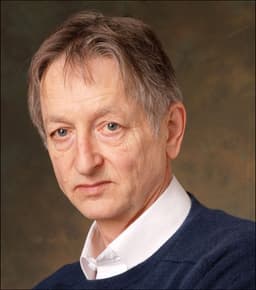
Architect · b. 1947
Geoffrey Hinton
He gave neural networks the ability to learn from their own mistakes, and in doing so, made modern AI possible.
“I have always been convinced that the only way to get artificial intelligence to work is to do it the way the brain does it.”
— Interview with the Guardian, 2023
Geoffrey Everest Hinton was born in Wimbledon, England, in 1947, into a family steeped in scientific distinction — his great-great-grandfather was the logician George Boole. He studied experimental psychology at Cambridge before pivoting to artificial intelligence, earning his PhD at the University of Edinburgh in 1978. From his earliest days as a researcher, he was drawn to a question most of his colleagues considered either solved or hopeless: could machines learn the way brains do? The dominant paradigm of the era was symbolic AI — rule-based, hand-engineered, and, to Hinton's mind, fundamentally misguided.
In 1986, Hinton, David Rumelhart, and Ronald Williams published a paper in Nature that formalized and popularized the backpropagation algorithm for training multi-layer neural networks. The paper demonstrated that a network could adjust its internal weights by propagating error signals backward through its layers — a mechanism that, in principle, allowed any sufficiently complex network to learn virtually any function from data. This was not entirely new mathematics, but Hinton and his colleagues made it work in practice and communicated its implications with unusual clarity. He would spend the following two decades refining and defending these ideas through periods when neural networks were widely dismissed in favor of support vector machines and other methods.
Recognition came slowly, then all at once. In 2012, a neural network designed in Hinton's Toronto lab — AlexNet, built with his students Alex Krizhevsky and Ilya Sutskever — won the ImageNet image recognition competition by a margin that shocked the computer vision community and signaled the beginning of the deep learning era. In 2018, Hinton shared the Turing Award with Yann LeCun and Yoshua Bengio, the so-called 'Godfathers of Deep Learning.' In 2024, he was awarded the Nobel Prize in Physics alongside John Hopfield for their foundational contributions to machine learning. He left Google in 2023, citing concerns about the dangers posed by the very technology he had spent his life building.
Key Works
- 1986
Learning Representations by Back-propagating Errors
Established backpropagation as a practical algorithm for training multi-layer neural networks, becoming the foundational training method for all modern deep learning.
- 2006
A Fast Learning Algorithm for Deep Belief Nets
Revived interest in deep neural networks by showing that greedy layer-wise pre-training could make deep architectures trainable, reigniting the field after a decade of neglect.
- 2012
ImageNet Classification with Deep Convolutional Neural Networks (AlexNet)
Demonstrated that deep convolutional networks trained on GPUs could dramatically outperform all other methods on large-scale image recognition, triggering the deep learning revolution in industry.
- 2014
Dropout: A Simple Way to Prevent Neural Networks from Overfitting
Introduced dropout regularization, a widely adopted technique that improved the generalization of neural networks across nearly every application domain.
- 2015
Distilling the Knowledge in a Neural Network
Introduced knowledge distillation, a technique for compressing large trained models into smaller ones, now used extensively to deploy AI efficiently on constrained hardware.
Backpropagation, as Hinton helped establish it, became the universal training algorithm for neural networks and remains so today. Every major AI system built in the last decade — language models, image classifiers, protein structure predictors, recommendation engines — is trained using gradient descent driven by backpropagated error signals. His subsequent work on Boltzmann machines and deep belief networks in the mid-2000s helped revive the field when it was at its lowest ebb, demonstrating that deep networks could be initialized in ways that made them trainable and showing that unsupervised pre-training was a viable strategy for learning useful representations.
Hinton's direct intellectual descendants shaped the modern AI landscape. Ilya Sutskever co-founded OpenAI. Alex Krizhevsky's AlexNet architecture directly inspired the convolutional network designs used across industry. Yann LeCun, a postdoctoral researcher under Hinton's influence, developed convolutional neural networks that became the backbone of computer vision. His ideas about distributed representations — the notion that concepts should be encoded as patterns across many units rather than single symbolic nodes — underpinned the word embedding revolution and ultimately the attention mechanisms at the heart of transformer models.
Legacy
Geoffrey Hinton's ideas run inside virtually every consequential AI system operating today. The backpropagation algorithm trains the large language models that answer questions, write code, and generate images. His intuitions about hierarchical feature learning animate the convolutional networks used in medical imaging, autonomous vehicles, and satellite analysis. His concept of distributed representations is the foundation of word embeddings, and word embeddings are the foundation of transformers, and transformers are the foundation of GPT, Gemini, and their successors. When a neural network of any kind adjusts itself in response to an error, it is executing a process Hinton spent decades insisting was worth understanding. The fact that he now worries about what that process has produced may itself be the most consequential statement he has ever made.
Learning Representations by Back-propagating Errors
David E. Rumelhart, Geoffrey E. Hinton, Ronald J. Williams · 1986
https://www.nature.com/articles/323533a0
ImageNet Classification with Deep Convolutional Neural Networks
Alex Krizhevsky, Ilya Sutskever, Geoffrey E. Hinton · 2012
https://papers.nips.cc/paper/2012/hash/c399862d3b9d6b76c8436e924a68c45b-Abstract.html
A Fast Learning Algorithm for Deep Belief Nets
Geoffrey E. Hinton, Simon Osindero, Yee-Whye Teh · 2006
https://www.cs.toronto.edu/~hinton/absps/fastnc.pdf
Geoffrey Hinton — Wikipedia
Wikipedia contributors · 2024
https://en.wikipedia.org/wiki/Geoffrey_Hinton