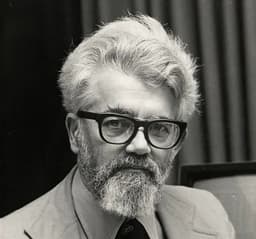
Founder · 1927–2011
John McCarthy
He named the field, convened its founders, and invented the language that gave early AI its mind.
“Every aspect of learning or any other feature of intelligence can in principle be so precisely described that a machine can be made to simulate it.”
— A Proposal for the Dartmouth Summer Research Project on Artificial Intelligence, 1955
John McCarthy was born on September 4, 1927, in Boston, Massachusetts, to Irish and Lithuanian Jewish immigrant parents who were active in the Communist Party — a childhood steeped in political argument and self-education that gave him an early appetite for rigorous, systematic thinking. He taught himself mathematics from university textbooks before entering high school, and went on to study mathematics at Caltech and Princeton, where he encountered the nascent ideas about computation and mind that would define his life's work. By his mid-twenties he was already convinced that human intelligence was, at its core, a formal process that machines could replicate.
In 1955, McCarthy co-authored the proposal for the Dartmouth Summer Research Project on Artificial Intelligence, coining the phrase 'artificial intelligence' and assembling a group that included Marvin Minsky, Claude Shannon, and Nathaniel Rochester. The 1956 conference did not produce breakthroughs on its own, but it gave a scattered set of ideas a name, a community, and a shared ambition. McCarthy then turned to the question of how machines should represent and reason about knowledge, and in 1958 he published his design for Lisp — a programming language built around symbolic expressions and recursive functions that became the primary vehicle for AI research for decades.
McCarthy spent the bulk of his career at MIT and then Stanford, where he founded the Stanford Artificial Intelligence Laboratory in 1962 and directed it for many years. He received the Turing Award in 1971 for his foundational contributions to AI, and continued working on problems of common-sense reasoning, nonmonotonic logic, and the formal representation of knowledge well into the 2000s. He died on October 24, 2011, in Stanford, California, having witnessed the field he named grow from a summer workshop into a global enterprise — though never quite as quickly as he had once hoped.
Key Works
- 1955
A Proposal for the Dartmouth Summer Research Project on Artificial Intelligence
Coined the term 'artificial intelligence' and established the research programme that gave the field its identity and its first community.
- 1960
Recursive Functions of Symbolic Expressions and Their Computation by Machine, Part I
Introduced Lisp, the programming language that became the primary tool of AI research and whose ideas permeate modern computing.
- 1959
Programs with Common Sense
Proposed the Advice Taker, an early vision of a system that could reason from general knowledge — anticipating knowledge bases and logical AI agents.
- 1980
Circumscription — A Form of Non-Monotonic Reasoning
Formalised how an AI system can draw reasonable conclusions from incomplete information, founding a major branch of knowledge representation theory.
- 1984
Some Expert Systems Need Common Sense
Articulated the limits of narrow expert systems and argued for the necessity of general common-sense knowledge — a challenge that still drives AI research today.
Lisp shaped the intellectual culture of AI research for at least three decades. Its core innovations — symbolic expressions, garbage collection, dynamic typing, and the treatment of code as data — influenced virtually every AI programming environment that followed, and its descendants include Scheme, Common Lisp, and Clojure, which remain in active use today. Beyond the language itself, McCarthy's framework of symbolic AI — the idea that intelligence could be captured by manipulating formal symbols according to logical rules — structured the research agenda of entire generations of scientists, producing expert systems, theorem provers, and planning algorithms that powered real-world applications from medical diagnosis to logistics.
McCarthy's later theoretical work was equally consequential. His formalization of nonmonotonic reasoning and the circumscription framework addressed a problem every AI system eventually faces: how to reason sensibly when information is incomplete or changes. These ideas fed directly into the field of knowledge representation and reasoning, and into the development of logic programming languages like Prolog. His concept of 'situations and actions,' developed in his 1963 paper on a computer program for chess, laid groundwork for the situation calculus that remains a foundational formalism in AI planning and robotics research.
Legacy
McCarthy's fingerprints are on the infrastructure of modern computing in ways that are easy to overlook precisely because they have become invisible. Lisp's ideas — higher-order functions, automatic memory management, interactive development environments — migrated into Python, JavaScript, and virtually every modern scripting language. The SAIL laboratory he built trained researchers who went on to found or lead major AI programs across academia and industry. His insistence that artificial intelligence was a legitimate scientific discipline, deserving of its own name and its own methods, made possible the institutional investments — university departments, funding programmes, research laboratories — that eventually produced the deep learning revolution he lived just long enough to see begin. The term he coined in 1955 is now used billions of times a day by people who have never heard his name.
A Proposal for the Dartmouth Summer Research Project on Artificial Intelligence
John McCarthy, Marvin L. Minsky, Nathaniel Rochester, Claude E. Shannon · 1955
http://www-formal.stanford.edu/jmc/history/dartmouth/dartmouth.html
Recursive Functions of Symbolic Expressions and Their Computation by Machine, Part I
John McCarthy · 1960
http://www-formal.stanford.edu/jmc/recursive.html
Circumscription — A Form of Non-Monotonic Reasoning
John McCarthy · 1980
http://www-formal.stanford.edu/jmc/circumscription.html
John McCarthy — Wikipedia
Wikipedia contributors · 2024
https://en.wikipedia.org/wiki/John_McCarthy_(computer_scientist)