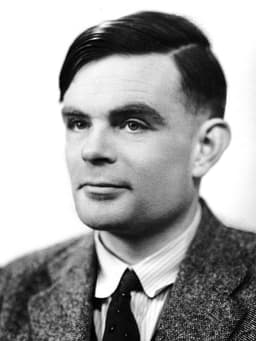
Theorist · 1912–1954
Alan Turing
He invented the theoretical machine that underlies every computer ever built, then asked whether such machines could one day think.
“We can only see a short distance ahead, but we can see plenty there that needs to be done.”
— Computing Machinery and Intelligence, Mind, 1950
Alan Mathison Turing was born in London on 23 June 1912, the son of a British civil servant stationed in India. He showed an extraordinary aptitude for mathematics and science from childhood, teaching himself calculus before he had been formally introduced to it, and winning a scholarship to King's College, Cambridge, where he read mathematics and graduated with first-class honours in 1934. Cambridge sharpened his instinct for foundational questions — not merely how to solve problems, but whether problems were solvable at all.
In 1936, at twenty-three, Turing published 'On Computable Numbers, with an Application to the Entscheidungsproblem,' a paper that addressed a challenge David Hilbert had posed to the mathematical world: could there exist a definite procedure to decide the truth or falsity of any mathematical statement? Turing's answer was no — and to prove it, he invented a hypothetical device, the Turing machine, capable of reading and writing symbols on an infinite tape according to a finite set of rules. The argument was devastating in its clarity: some problems are undecidable, and the Turing machine made that precise. What he had also done, almost as a side effect, was describe the logical architecture of the universal computer. During the Second World War, this theoretical work found urgent practical application when Turing joined the Government Code and Cypher School at Bletchley Park, leading the effort to break the German Enigma cipher. His statistical method, the Bombe, helped decrypt thousands of intercepted messages and is credited by historians with shortening the war by years.
After the war, Turing worked at the National Physical Laboratory and then at the University of Manchester, where he contributed to the design of early stored-program computers. In 1950 he published 'Computing Machinery and Intelligence,' posing the question 'Can machines think?' and proposing the Imitation Game — later known as the Turing Test — as a practical criterion for machine intelligence. His final scientific work turned toward mathematical biology, exploring how chemical processes might generate the patterns seen in living things. In 1952 Turing was prosecuted under British obscenity laws for his relationship with another man and subjected to chemical castration as a condition of probation. He died on 7 June 1954, aged forty-one, from cyanide poisoning; an inquest recorded suicide, though the circumstances have never been fully resolved. He received a royal pardon posthumously in 2013.
Key Works
- 1936
On Computable Numbers, with an Application to the Entscheidungsproblem
Introduced the Turing machine and proved the existence of undecidable problems, establishing the theoretical foundation for all of computer science.
- 1950
Computing Machinery and Intelligence
Posed the question 'Can machines think?' and proposed the Imitation Game, launching the philosophical and scientific programme of artificial intelligence.
- 1945
Proposed Electronic Calculator (NPL Report)
Outlined the design of the Automatic Computing Engine, one of the first detailed proposals for a stored-program electronic computer.
- 1952
The Chemical Basis of Morphogenesis
Demonstrated mathematically how reaction-diffusion chemical systems could produce the biological patterns seen in animal coats and plant growth, founding computational morphogenesis.
The Turing machine gave computer science its bedrock. Every subsequent theory of computation — from Alonzo Church's lambda calculus to the complexity classes explored by Stephen Cook and Richard Karp in the 1970s — is built on or measured against Turing's model. When computer scientists speak of what is and is not computable, they are speaking Turing's language. John von Neumann drew on the concept of the universal Turing machine when articulating the stored-program architecture that defines virtually every modern processor, and he acknowledged the debt explicitly. Without the 1936 paper, the theoretical scaffold on which hardware and software engineering rests would simply not exist.
The 1950 paper on computing machinery and intelligence seeded an entirely separate discipline. It gave early researchers a shared vocabulary and a concrete benchmark, animating the founding generation of AI scientists including John McCarthy, Marvin Minsky, and Claude Shannon, who gathered at the 1956 Dartmouth Conference to formalize the field Turing had already named in spirit if not in letter. The Turing Test remains the most widely debated criterion in philosophy of mind, provoking responses from John Searle's Chinese Room argument to contemporary debates about large language models. His 1952 paper on morphogenesis — the chemical basis of pattern formation in biology — anticipated an entire field of computational biology and reaction-diffusion modelling that researchers are still actively developing.
Legacy
Alan Turing's ideas have never stopped running. Every laptop, smartphone, and server operates on a logical architecture that descends directly from the universal Turing machine. The question he posed in 1950 — whether a machine could exhibit intelligent behaviour indistinguishable from a human's — shapes the evaluation and public debate around every large language model and conversational AI system released today. His work on morphogenesis is actively applied in developmental biology and in the generation of synthetic textures in computer graphics. The UK's national programme for AI research bears his name, and his face appeared on the British fifty-pound note from 2021 — a formal, if belated, acknowledgement that the conceptual foundations of the digital age were laid by one man working, in large part, alone.
On Computable Numbers, with an Application to the Entscheidungsproblem
Alan M. Turing · 1936
https://www.cs.virginia.edu/~robins/Turing_Paper_1936.pdf
Computing Machinery and Intelligence
Alan M. Turing · 1950
https://doi.org/10.1093/mind/LIX.236.433
The Chemical Basis of Morphogenesis
Alan M. Turing · 1952
https://doi.org/10.1098/rstb.1952.0012
Alan Turing — Wikipedia
Wikipedia contributors · 2024
https://en.wikipedia.org/wiki/Alan_Turing