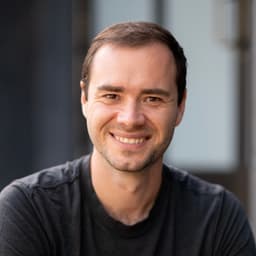
Translator · b. 1985
Andrej Karpathy
More than almost anyone alive, Karpathy made deep learning something a working engineer could understand, build, and trust.
“The most common neural net mistakes: you didn't try to overfit a single batch first. You forgot to toggle train/eval mode. You forgot to .zero_grad() before .backward(). You passed softmax output to a loss that expects logits.”
— Karpathy, 'A Recipe for Training Neural Networks,' karpathy.github.io, 2019
Andrej Karpathy was born in Slovakia in 1986 and immigrated with his family to Toronto as a child. He studied computer science and physics at the University of Toronto before completing a master's degree at the University of British Columbia. He arrived at Stanford for his PhD at a moment of extraordinary ferment — Geoffrey Hinton's group had just demonstrated that deep networks could recognize objects, and the question of what these systems could actually do was still radically open.
At Stanford, Karpathy worked under Fei-Fei Li and became deeply interested in the junction of vision and language — in teaching machines not just to classify images but to describe them. His 2015 paper 'Deep Visual-Semantic Alignments for Generating Image Descriptions' showed that a network could learn to connect regions of an image to fragments of natural language, producing captions that were, for their time, startlingly fluent. That same year he published 'The Unreasonable Effectiveness of Recurrent Neural Networks,' a blog post demonstrating that character-level language models trained on raw text could generate coherent prose, code, and even mathematical notation — a result that captured imaginations across the entire field.
After completing his PhD, Karpathy joined OpenAI as a founding research scientist, contributing to early work on reinforcement learning and generative models. In 2017 he left to become Director of AI at Tesla, where he led the team responsible for Autopilot's neural network perception stack — overseeing the shift from radar-based sensing to a vision-only system processing eight cameras in real time. He returned to OpenAI in 2023 before departing later that year to pursue independent work, including the educational project that many consider his most enduring contribution: a from-scratch reimplementation of modern language model training called nanoGPT.
Key Works
- 2015
Deep Visual-Semantic Alignments for Generating Image Descriptions
Demonstrated that neural networks could learn fine-grained correspondences between image regions and natural language phrases, establishing a foundational pattern for multimodal AI.
- 2015
The Unreasonable Effectiveness of Recurrent Neural Networks
A blog post that showed character-level language models could generate strikingly coherent text, code, and structure, catalyzing widespread interest in sequence modeling before transformers dominated the field.
- 2015
CS231n: Convolutional Neural Networks for Visual Recognition
The Stanford course he co-created and taught became the most widely watched deep learning curriculum in the world, training an entire generation of practitioners in visual recognition and neural network fundamentals.
- 2019
A Recipe for Training Neural Networks
A practical diagnostic guide to neural network training failures that became the standard reference for debugging deep learning systems in industry.
- 2022
nanoGPT
A minimal, readable PyTorch reimplementation of GPT-2 training that demystified large language model architecture for thousands of engineers and researchers worldwide.
Karpathy's influence operates at two distinct levels. As a researcher, his work on image captioning and visual-semantic alignment helped establish the encoder-decoder paradigm that now underlies multimodal systems from GPT-4V to Google Gemini. His early experiments with recurrent networks and reinforcement learning at OpenAI fed directly into the research culture that produced systems like GPT-2 and beyond. At Tesla, he built and scaled one of the largest applied neural network deployments in history, processing petabytes of real-world driving video to train perception models that operated on embedded hardware at the edge.
As an educator, his reach is harder to quantify but arguably more consequential. His Stanford course CS231n — Convolutional Neural Networks for Visual Recognition — was recorded and released freely online, becoming the de facto introduction to deep learning for hundreds of thousands of engineers worldwide. His blog posts, including the neural network training recipe and his treatment of backpropagation as a concrete, debuggable procedure, gave working practitioners the mental models they needed to move from confusion to competence. When he released nanoGPT in 2022, a minimal, readable implementation of GPT-2 training in roughly 300 lines of PyTorch, it became an immediate reference point for anyone trying to understand how modern language models actually work from the ground up.
Legacy
The concepts Karpathy clarified — the training loop as a debugging process, the transformer as something you can read and rewrite, the image as a sequence of learnable patches — now live inside the intuitions of a generation of engineers who never met him. CS231n lecture videos remain in active circulation. nanoGPT is forked and extended continuously on GitHub, used as a teaching tool in universities and as a research scaffold in labs. The perception architecture he built at Tesla continues to process millions of miles of driving data. Perhaps most durably, his insistence that understanding should precede application — that you must be able to write the thing before you trust the thing — has become a professional ethic in machine learning that outlasts any single model or framework.
Deep Visual-Semantic Alignments for Generating Image Descriptions
Andrej Karpathy, Li Fei-Fei · 2015
https://arxiv.org/abs/1412.2306
Andrej Karpathy — Wikipedia
Wikipedia contributors · 2024
https://en.wikipedia.org/wiki/Andrej_Karpathy
nanoGPT — GitHub Repository
Andrej Karpathy · 2022
https://github.com/karpathy/nanogpt
CS231n: Convolutional Neural Networks for Visual Recognition — Course Page
Andrej Karpathy, Fei-Fei Li, Justin Johnson · 2015
http://cs231n.stanford.edu