
Apr 24, 2026 · 6 min read
AI is often described as unpredictable. Give it the same input twice and you may get two different outputs. For many, this is a flaw, a limitation of the technology and a reason not to trust it in critical systems. But that assumption is fundamentally wrong.
Unpredictability is not a failure of intelligence. It is a property of it.
Humans behave the same way. The same question, asked twice, can produce different answers depending on context, interpretation, and intent. Intelligence is not a static mapping from input to output. It is a dynamic process of understanding.
The real problem is not that AI is unpredictable. It is that we are building systems without deciding when predictability is required and when it is not. This piece introduces a framework for thinking about AI systems not as inherently consistent or inconsistent, but as systems that must be intentionally designed along a spectrum between determinism and creativity.
Innovation is unpredictable. Thinking outside the box is unpredictable. The most significant ideas often appear irrational or unexpected at first. If a system is perfectly predictable, it is probably not very intelligent.
The more intelligent a system is, the more it explores possibilities rather than repeating fixed patterns. It recombines ideas, creates variations, and generates outcomes that were never explicitly programmed. Variability is not the opposite of intelligence. It is its signature.
Not all systems are allowed to be unpredictable. When we build systems, especially in production environments, we expect consistency, repeatability, and reliability. This creates a fundamental tension: intelligence thrives on variation, but systems demand stability.
So we face a core decision: do we want intelligence, or do we want stability? In many cases, we cannot fully maximize both at the same time. The answer lies not in choosing one side, but in designing deliberately for where your system sits.
To resolve this tension, we need to stop treating AI as a single type of system and instead design for two distinct modes.
In creative and exploratory contexts, unpredictability is not just acceptable, it is necessary. Writing, idea generation, product brainstorming, simulations: these are places where we want multiple outputs, different versions, different perspectives, different interpretations. Value comes from comparison. You do not get better ideas by forcing one answer. You get them by generating many and selecting the best.
When we select the best output and feed it back into the system, we create a loop: generation, evaluation, selection, refinement. This is not just engineering. It is evolution. AI in creative mode behaves less like a calculator and more like a biological system. Variation is generated. The environment selects. The system improves.
In operational contexts, the dynamic inverts. Financial processing, legal data extraction, analytics pipelines, automation systems: here we need deterministic behavior, consistent outputs, and strict validation. In these systems, variability is not creativity. It is failure. The most important tool for making AI predictable is structure. A well-defined schema reduces ambiguity. We do not remove intelligence. We constrain its degrees of freedom.
Consider a real scenario. You have thousands of financial documents: scanned PDFs, images, self-reported forms. You need to extract revenue, costs, liabilities, and structured KPIs and output them into a database, a BI tool, or a decision system.
You process the same PDF twice. The first run returns a revenue figure of €120,000. The second returns €118,500. Nothing looks wrong on the surface. But your system is now inconsistent. Your dashboards shift. Your decisions shift. Your trust disappears. A system that is 98 percent correct but 2 percent inconsistent is not reliable. It is dangerous.
This is the real challenge of AI engineering: how do you turn a probabilistic system into a reliable component of a deterministic pipeline? By default, AI interprets and systems execute. Interpretation introduces variation. Deciding where that variation is tolerated, and where it is not, is the design problem.
Contrast this with generating a novel. From the same input, you can produce different storylines, different characters, different emotional arcs, and none of them are wrong. In creative systems, variation is not a bug. It is the product.
Most systems are not purely one or the other. They exist on a spectrum between full determinism and full creativity, and every system can be given a coordinate on that grid.
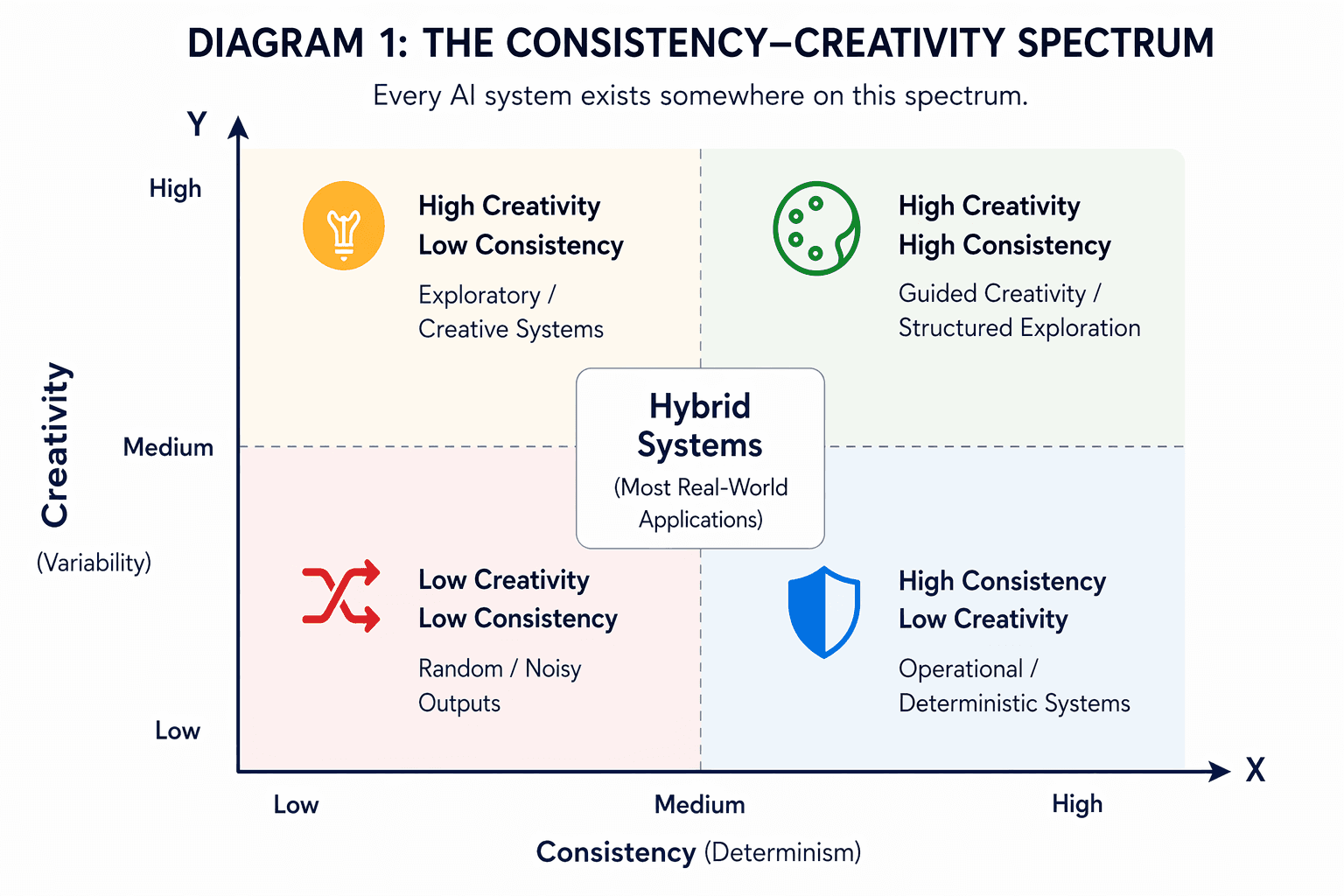
High consistency and low creativity describes an operational system. Low consistency and high creativity describes a creative one. Most real-world applications sit somewhere in the middle, which is where the most interesting design decisions happen. Even creative systems follow structure: story arcs, pacing, coherence. Even deterministic systems may need flexibility for edge cases and interpretation layers. The goal is not randomness. It is controlled creativity, where variation generates options and consistency filters quality.
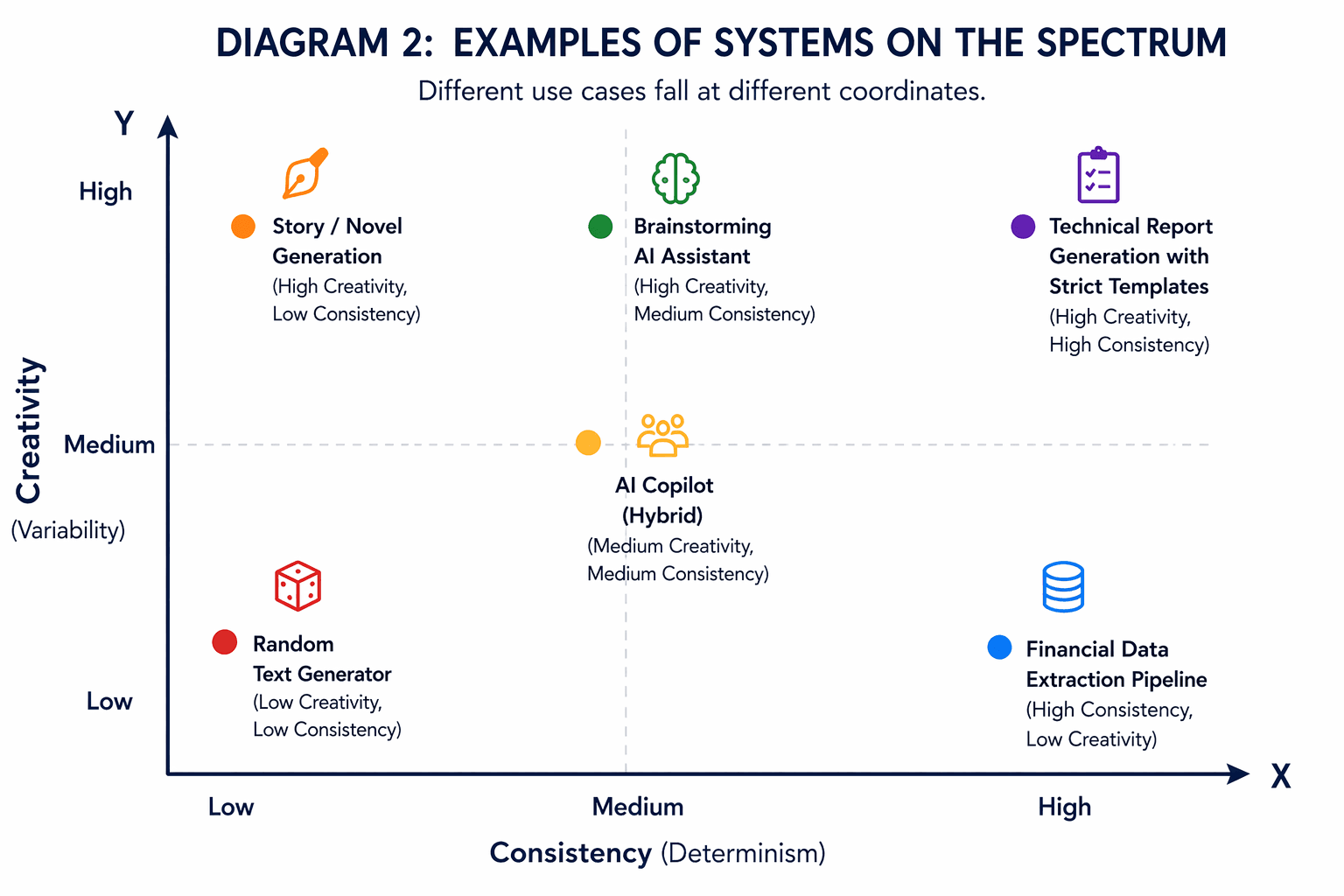
The real challenge is not choosing one side. It is positioning your system correctly and designing for that position.
Before building any AI system, the first design decision is simple: what kind of output are you expecting? Fixed and repeatable, or variable and exploratory? This is not a detail. It is the foundation of the system.
Five questions define the design coordinates of any AI system. First, the determinism requirement: must outputs always match exactly? Second, the evaluation type: is correctness objective, or is quality subjective? Third, system dependency: does the output feed into machines or into humans? Fourth, variance tolerance: is variation useful in this context or harmful? Fifth, the feedback loop: is this a single-shot output or an iterative improvement process?
Each system becomes a coordinate on the spectrum. Plotting that coordinate tells you which architectural patterns apply.
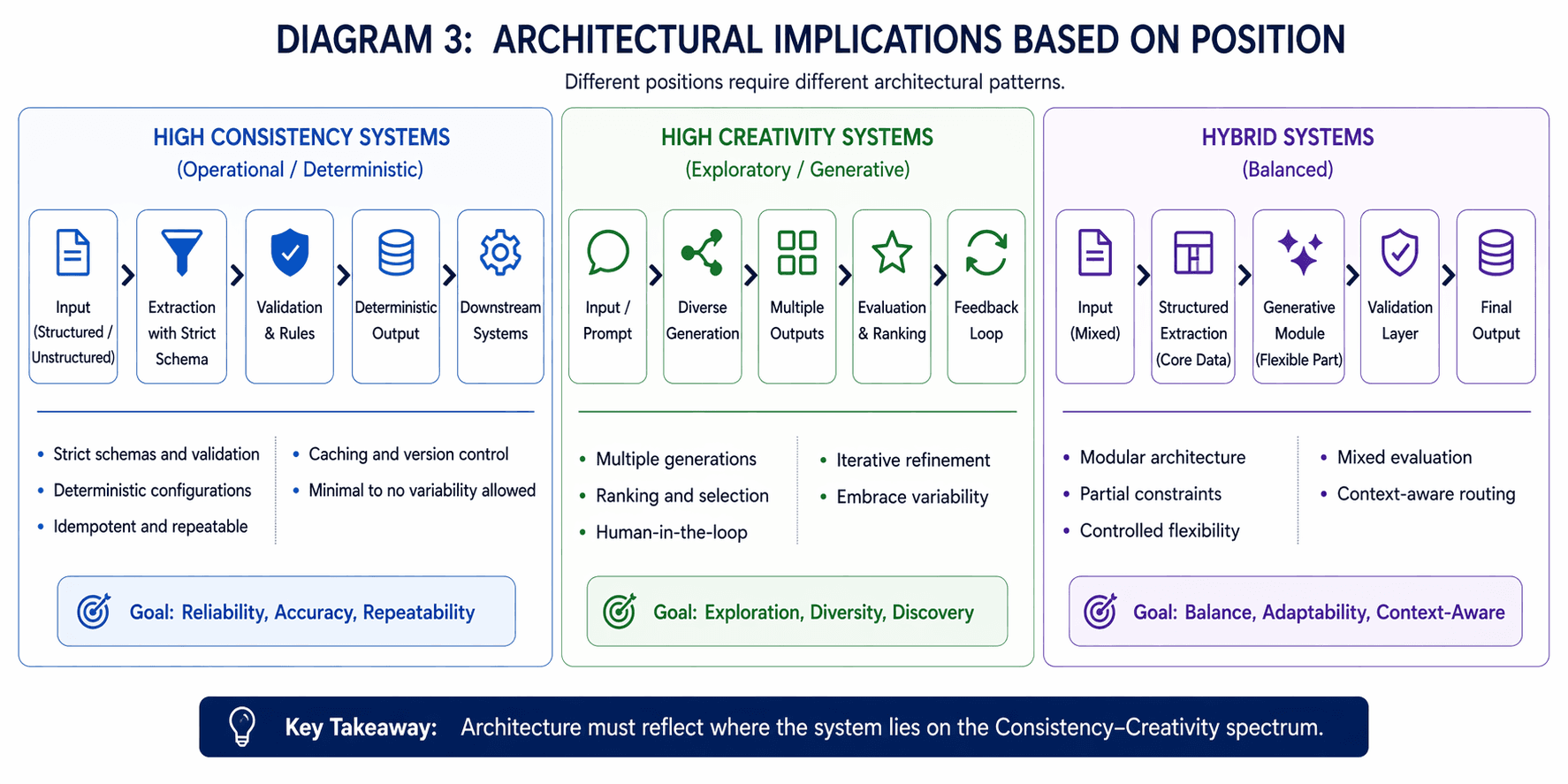
High-consistency systems call for strict schemas, validation layers, deterministic configurations, and caching. High-creativity systems call for diverse generation, multiple outputs, ranking loops, and human feedback in the loop. Hybrid systems require modular pipelines, partial constraints, and mixed evaluation strategies.
The key shift is in how we frame the question. Instead of asking whether AI is consistent, we ask whether the system is correctly designed for its position on the spectrum. Reliability does not come from removing variability. It comes from deciding exactly where variability is allowed to exist.
AI systems are not inherently unreliable. They are probabilistic engines of intelligence.
The future of AI engineering is not forcing intelligence into determinism. It is designing systems that know when to explore and when to behave like infrastructure.

Alan Salomon
AI engineer and writer